Press Release





Newly Designed Topics Focused on Goals and Enjoyment Chosen in More Than 80% of Dialogues, with Conversations Leading to Improved Well-Being
A research group from the Advanced Telecommunications Research Institute International (ATR)'s Deep Interaction Laboratory Group, in collaboration with Nagasaki University, the University of Osaka, Nara Institute of Science and Technology, and Kyoto University, developed a dialogue robot designed to help psychiatric day care patients organize their thoughts. The system was evaluated through a 24-month field study at the psychiatric day care center "Sakura no Saku Oka" operated by Arima Kogen Hospital.
During the first 14 months, the research team continuously improved the system based on feedback from users, staff members, and clinicians. During the remaining 10 months, the completed system was formally evaluated.
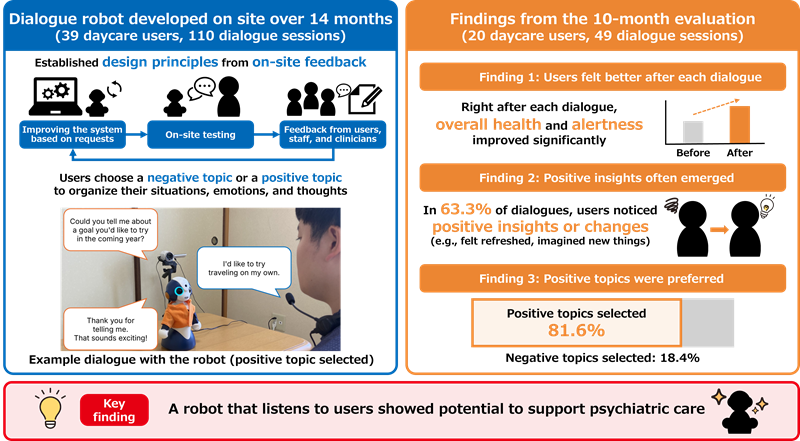
Figure 1: Overview of the study and the key findings
Participants selected either topics focused on reflecting on worries and regrets, which have traditionally been used in support systems, or newly designed topics centered on future goals and enjoyable experiences that were developed in response to requests from day care staff. They then described their situations, feelings, and thoughts by answering the robot's questions, and before and after each conversation they rated their subjective overall health, alertness, and emotional valence on a scale from 0 to 100, where 0 represented the lowest possible state and 100 represented the highest possible state.
The analysis showed that a single conversation significantly improved self-ratings of subjective overall health and alertness. In other words, participants generally felt better after talking with the robot. Importantly, these positive effects remained consistent even after repeated use. In 63.3% of the dialogues, participants' post-conversation reflections described positive realizations or beneficial changes.
Furthermore, 81.6% of the selected topics were from the newly developed "goals and enjoyable experiences" category. This finding suggests that, alongside discussions about worries, opportunities to talk about personal goals and positive experiences are also highly valuable. The researchers hope these findings will contribute to the development of effective support technologies for psychiatric care settings where human resources are limited.
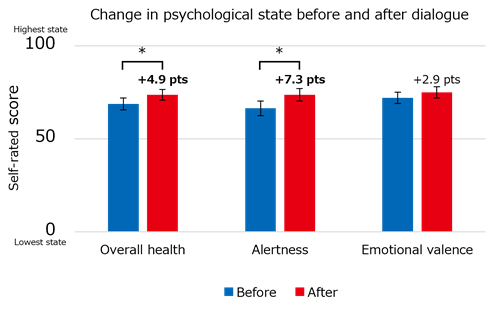
Figure 2: Results showing improvements in subjective overall health and alertness after the dialogue session (* indicates a statistically significant difference)
Psychiatric day care facilities provide rehabilitation services that help people with mental illnesses maintain stable lives and reintegrate into society. Various programs are offered, including relapse prevention and social skills training. Among the most important skills these programs aim to foster is self-monitoring, the ability to objectively observe and organize one's own thoughts, feelings, and circumstances.
However, objectively examining one's internal experiences alone can be difficult, and previous research has shown that support can make this process more effective. At the same time, psychiatric day care centers often face limitations in staffing and resources, making continuous individualized support challenging.
Dialogue systems have therefore attracted interest as potential support tools. Socially interactive robots are particularly promising because their physical presence and conversational nature encourage self-disclosure. However, previous studies have mostly involved short-term experiments with healthy participants, leaving unanswered questions about whether such systems could function effectively in real clinical settings and what design considerations would be necessary.
The goal of this study was to deploy a dialogue robot in an actual psychiatric day care environment and identify both the design principles required and the value such a system could provide to users.
The researchers adopted a practice-informed design approach rather than developing the system entirely in the laboratory before deployment. Day care users interacted with the robot while staff members such as occupational therapists and nurses, together with clinicians including psychiatrists and clinical psychologists, observed the sessions. After each interaction, feedback was gathered from participants, followed by discussions among researchers and clinicians to improve the system.
Through 16 experimental days (110 dialogue sessions) conducted over 14 months, five key design principles were established:
Questions should be brief and structurally straightforward because users may have difficulty determining when the robot has finished speaking.
Rather than interpreting silence as the end of speaking, the robot waits until the participant explicitly indicates completion.
Because automated advice can easily become inappropriate when context is not fully understood, the robot functions primarily as an accepting listener rather than evaluating or directing users.
Conversations are not limited to problems and concerns but also include hopes and positive experiences.
Clinicians can intervene when necessary and later resume the conversation once the participant's condition has been confirmed.
One of the most significant changes during development was the removal of an early advice-giving function and the expansion of available topics from worries alone to include hopes and positive experiences.
During the final 10-month evaluation period, participants selected one of five conversation topics and then rated their condition before and after the interaction. Forty-nine conversations were analyzed.
The results showed the following changes after each conversation:
Alertness: average increase of 7.3 points (p = .005)
Emotional valence: average increase of 2.9 points (p = .089), showing a marginally significant positive trend.
These effects remained consistent regardless of how many times an individual participated. Because attendance at psychiatric day care services is often irregular, the finding that benefits can occur from a single conversation has practical significance.
Among the 49 conversations, 40 focused on positive topics rather than problem-centered ones, indicating a statistically significant preference (p < .001). The most frequently selected topic was "A goal for the coming year," followed by "A happy memory from the past year." These preferences were observed across a wide range of participants rather than being concentrated among only a few individuals, suggesting that while discussing worries remains important, conversations about personal goals and positive experiences may be equally valuable in psychiatric day care settings.
At the end of each session, participants were asked whether they noticed any changes in their feelings or gained new insights, and independent evaluators categorized their responses. The analysis showed that 63.3% of responses described positive realizations or psychological changes, a proportion that was significantly higher than that of any other category. Participants reported reflections such as "I felt refreshed after being able to talk about my feelings" and "It was positive to be able to look back on the past and imagine new things." Others commented on the system itself, saying, "I can talk without being nervous, unlike with other people."
The robot completed 40 of the 49 conversations (81.6%) entirely autonomously, while in the remaining cases only minor assistance was needed to determine when participants had finished speaking. No emergency interruptions were required during the evaluation period.
This research helps bridge the gap between laboratory-based studies and real clinical practice, demonstrating the potential value of dialogue robots in psychiatric care. Future developments may include:
Real-time feedback that responds to the user's emotional state
Long-term support that helps individuals track changes in their mental state over time
Physical interactions that leverage the robot's embodied presence to provide additional forms of supportive engagement.
The researchers believe such advances could transform dialogue robots from tools for one-time self-monitoring into companions capable of supporting sustained psychological growth and well-being.
Title: A Social Robot for Self-Monitoring Support in Psychiatric Daycare: A 24-Month Iterative Development and Practical Evaluation
Authors: Takuto Akiyoshi(ATR), Hidenobu Sumioka(ATR), Hirokazu Kumazaki(Nagasaki University), Junya Nakanishi(The University of Osaka), Hirokazu Kato(Nara Institute of Science and Technology), and Masahiro Shiomi(ATR/ Kyoto University)
DOI:https://doi.org/10.1145/3857348
For more information, please refer to the full article published in ACM Transactions on Human-Robot Interaction.