A Company Founded to Pursue Basic Research
ATR is a unique company whose core business is basic research.
Although ATR has always operated with a distinctive mission that differs from the conventional profit-driven model of a stock company, we were able to celebrate our 35th anniversary thanks to the generous support and cooperation of all those involved, as well as the dedication of our distinguished predecessors and researchers.
We will continue to strengthen relationships of trust with our shareholders, whose strong support enables the continuation of our business, and will strive to enhance ATR's corporate value as a company engaged in basic research.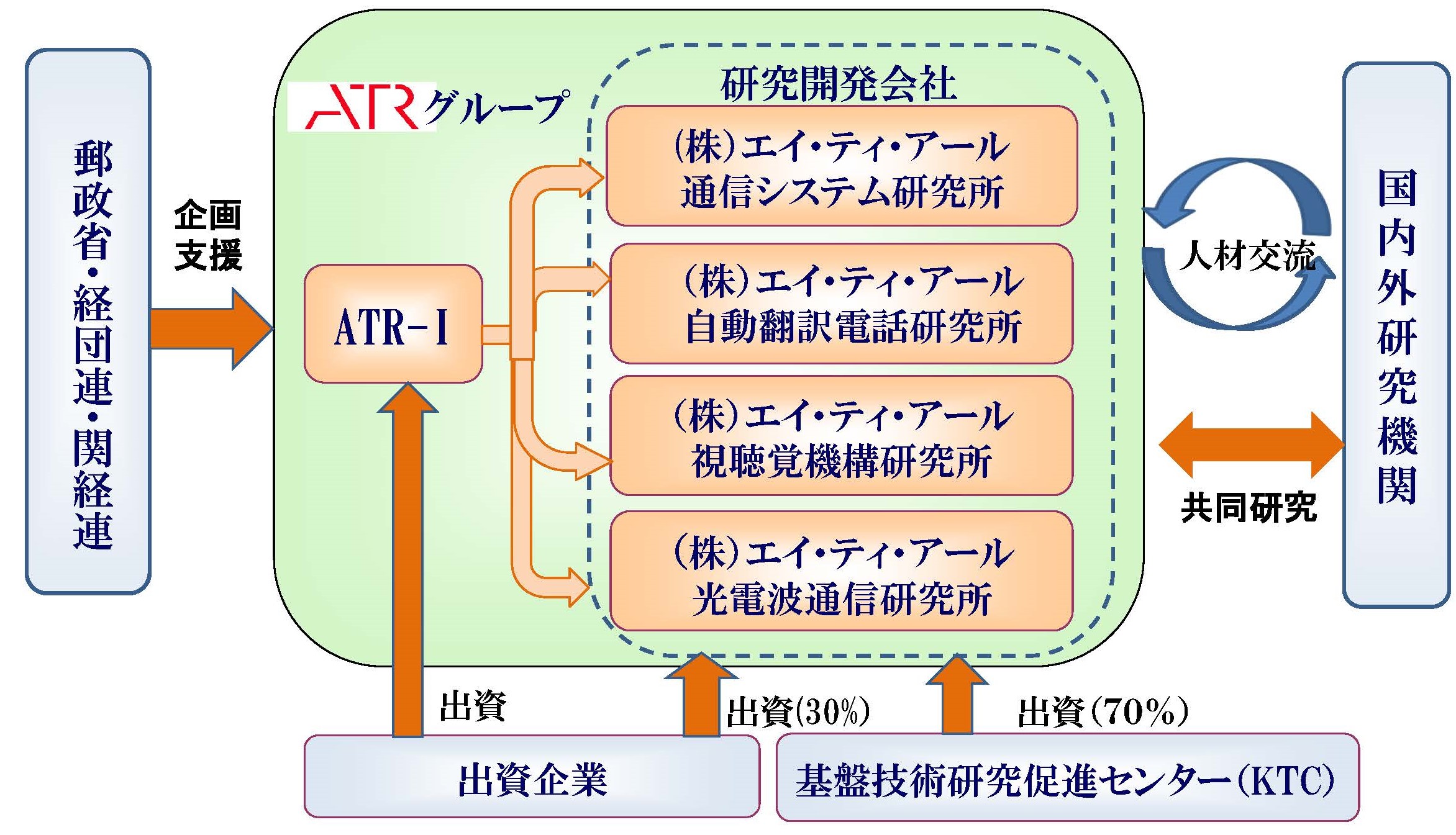 As described in History of ATR, in April 1985, Nippon Telegraph and Telephone Public Corporation was privatized. In October 1985, the Japan Key Technology Center (KTC) was established as an organization to support basic and advanced research through private-sector initiative, using dividends from the government-held shares of NTT.
ATR was established in March 1986 as a stock company dedicated to advanced basic research in telecommunications, based on plans developed by the Ministry of Posts and Telecommunications, NTT, major member companies of the Kansai Economic Federation, universities, and other organizations, with investment from KTC.
Since its founding, ATR has pursued ambitious, long-term research themes such as VR-based video conferencing systems, automatic speech translation telephony, and optical inter-satellite communications—technologies that are only now, 35 years later, beginning to reach practical use.
As described in History of ATR, in April 1985, Nippon Telegraph and Telephone Public Corporation was privatized. In October 1985, the Japan Key Technology Center (KTC) was established as an organization to support basic and advanced research through private-sector initiative, using dividends from the government-held shares of NTT.
ATR was established in March 1986 as a stock company dedicated to advanced basic research in telecommunications, based on plans developed by the Ministry of Posts and Telecommunications, NTT, major member companies of the Kansai Economic Federation, universities, and other organizations, with investment from KTC.
Since its founding, ATR has pursued ambitious, long-term research themes such as VR-based video conferencing systems, automatic speech translation telephony, and optical inter-satellite communications—technologies that are only now, 35 years later, beginning to reach practical use.
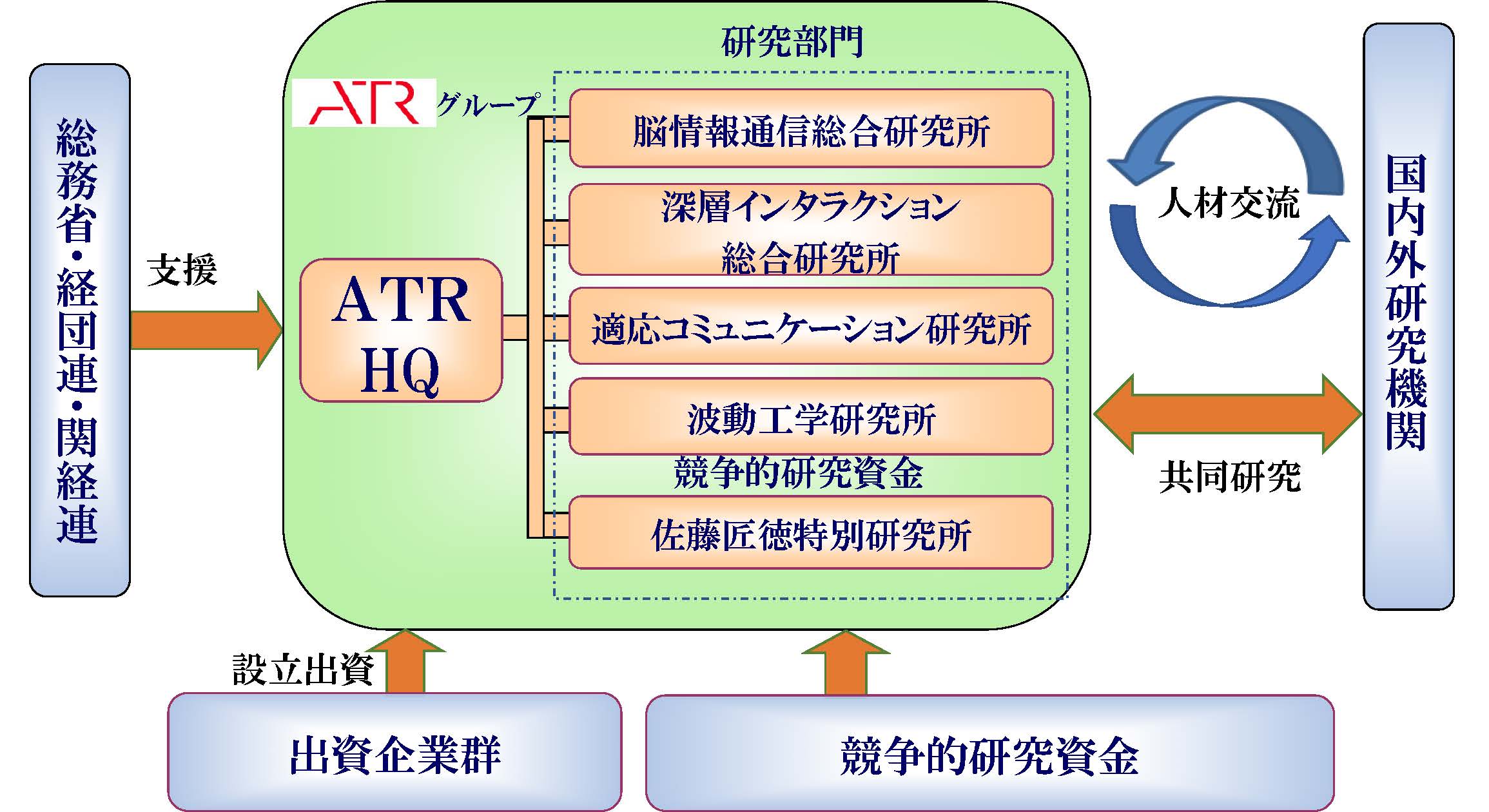 ATR's unique form as a stock company engaged in basic research arose from the framework and constraints of KTC investment. Even after the KTC and private-sector investment scheme for research and development companies ended in fiscal 2000, ATR has continued to produce steady research achievements under the organizational framework shown here.
|
History
Research Achievements |
Corporate Philosophy
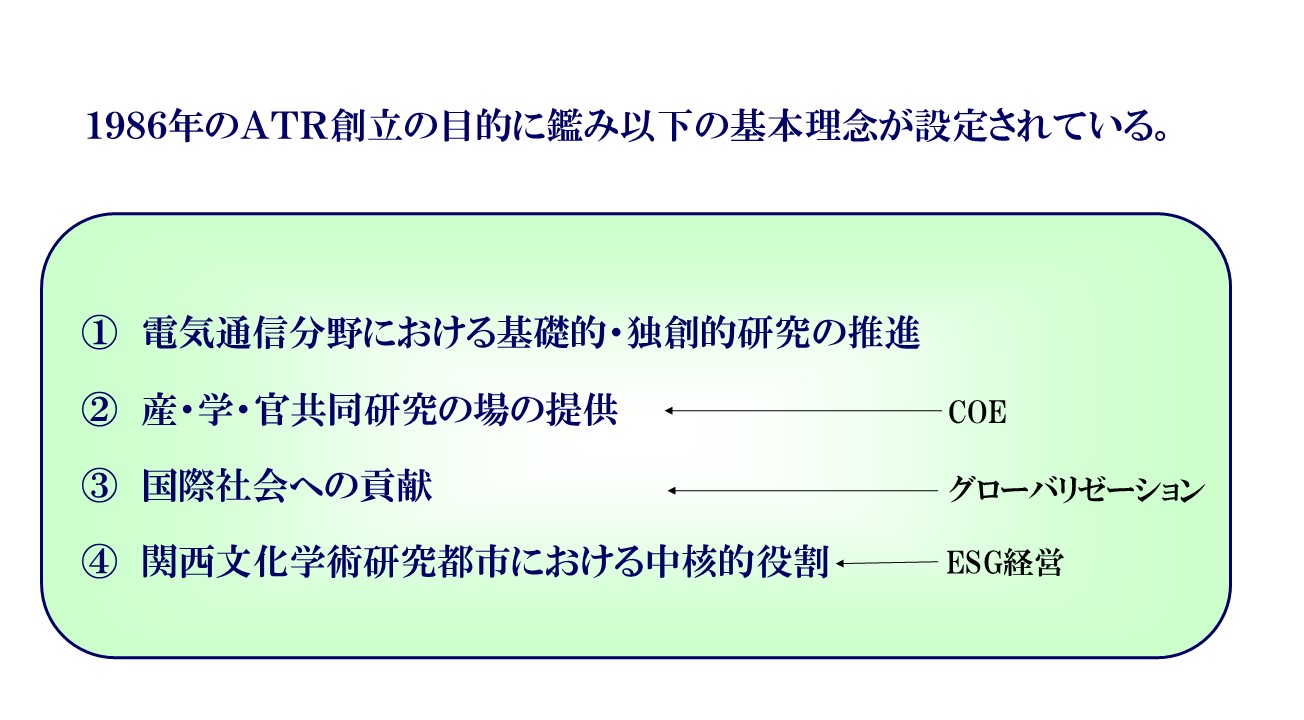 ATR has conducted its corporate operations based on the four Basic Principles established 35 years ago. The first principle is to pursue valuable research in information and communications technology (ICT). The second is to become a Center of Excellence (COE), not only in Japan but also internationally, through close collaboration with universities and other external research institutions. The third, contribution to the international community, corresponds to what is now called globalization. The fourth, "playing a central role in Kansai Science City," represents ATR's responsibility as the first research institution established in Keihanna Science City and reflects an approach aligned with ESG management, which has attracted growing attention in Japan in recent years.
Although these principles were formulated 35 years ago, ATR has operated under a remarkably forward-looking corporate philosophy that remains highly relevant today. |
Realizing a Healthy Longevity Society Is ATR's R&D Goal
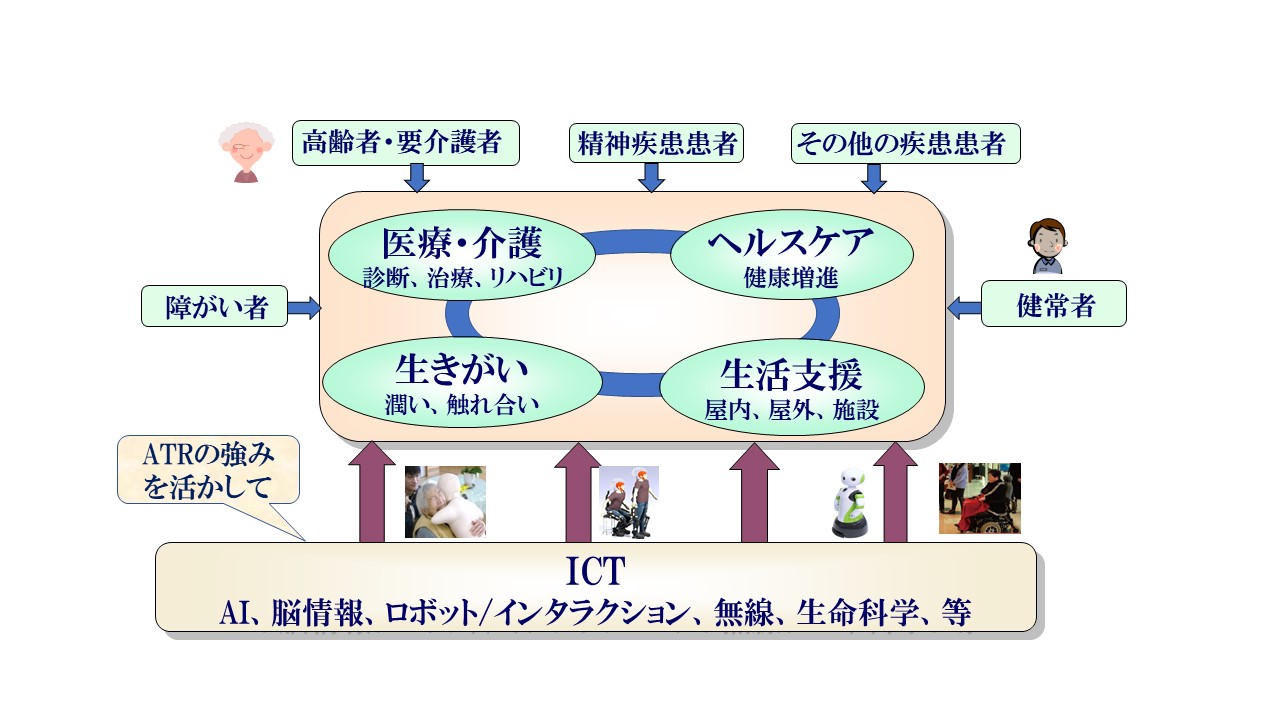 ATR aims to create a society in which individuals can design and enjoy their own 100-year lives.
Among the 17 Sustainable Development Goals (SDGs), ATR does not focus solely on Goal 9, "Industry, Innovation and Infrastructure." We also position Goal 3, "Good Health and Well-being," Goal 5, "Gender Equality," and Goal 8, "Decent Work and Economic Growth," as important objectives of our research and development activities.
ATR aims to create a society in which individuals can design and enjoy their own 100-year lives.
Among the 17 Sustainable Development Goals (SDGs), ATR does not focus solely on Goal 9, "Industry, Innovation and Infrastructure." We also position Goal 3, "Good Health and Well-being," Goal 5, "Gender Equality," and Goal 8, "Decent Work and Economic Growth," as important objectives of our research and development activities.
Through research in brain information science, robotics, life sciences, and wireless communications, ATR has sought to build technological foundations that can revitalize not only individuals but also society as a whole in an aging Japan, thereby contributing to the SDGs. A distinctive feature of ATR's approach is that it goes beyond healthcare and medical services to consider technologies that support people's sense of purpose and fulfillment in life. |
How ATR Conducts Its Research Business
ATR has research laboratories in brain information science, robotics, life sciences, and wireless communications. The core technological concept underlying these fields is, in our view, "network-oriented data processing technology."
To realize a rich and healthy longevity society, it will be necessary to enhance social life and to extend individual capabilities in response to the challenges of aging.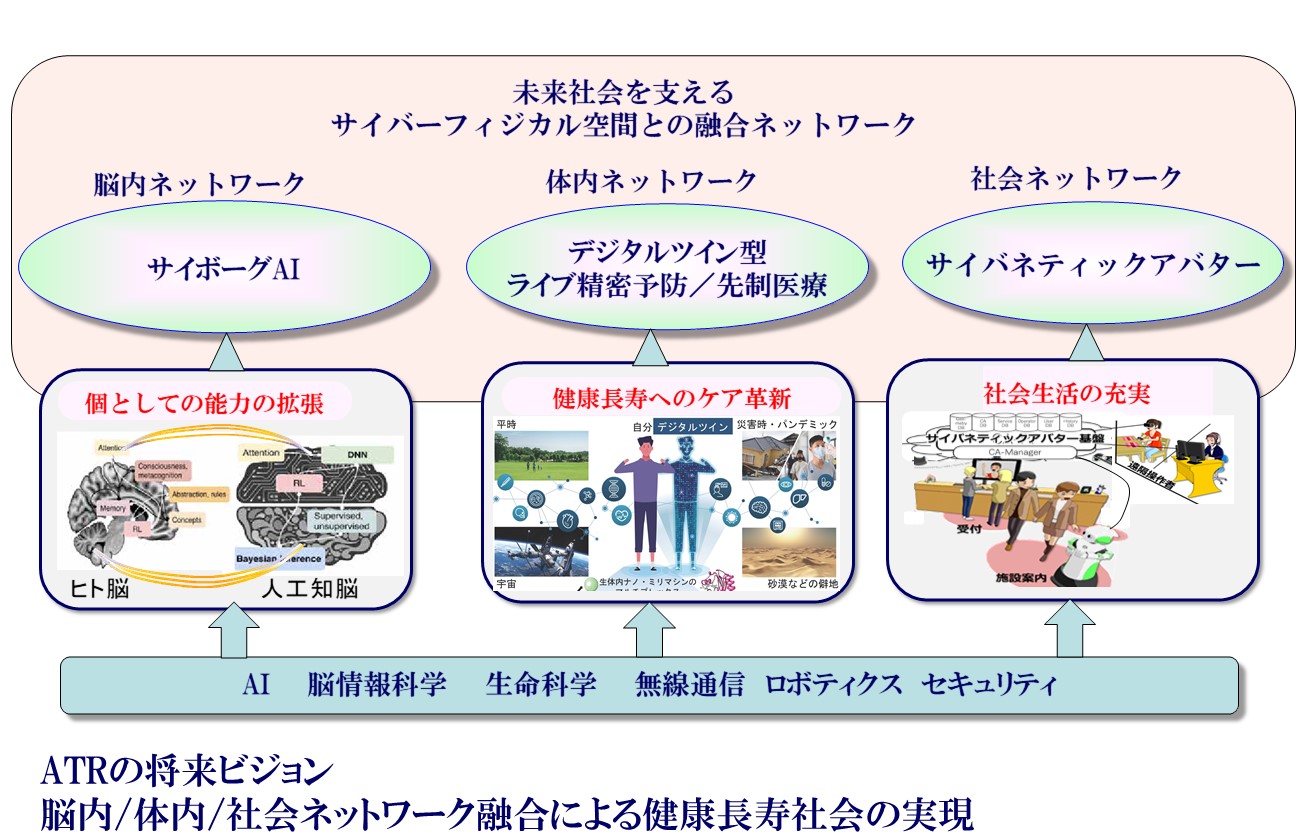 For the first objective, ATR advocates cybernetic avatars, aiming to enrich human-to-human communication without being constrained by physical distance.
For the second, ATR advocates cyborg AI, aiming to augment human intellectual capabilities with the power of computers.
The first requires insight into social networks among people, while the second requires knowledge of networks within the individual brain, that is, neuroscience.
Although different in nature from the networks traditionally discussed in wireless communications, internal bodily networks among organs and other systems are also important from the perspective of health and life sciences.
In this way, the technological concept supporting today's ATR lies in network-oriented data processing technology.
As a company engaged in basic research, ATR’s value has lain in serving as a Center of Excellence (COE), undertaking high-risk advanced research with partner institutions, and transferring both research outcomes and human talent to related companies.
ATR has a history of receiving investment from related companies seeking access to advanced technologies, and we hope to continue fulfilling that role in the future.
For the first objective, ATR advocates cybernetic avatars, aiming to enrich human-to-human communication without being constrained by physical distance.
For the second, ATR advocates cyborg AI, aiming to augment human intellectual capabilities with the power of computers.
The first requires insight into social networks among people, while the second requires knowledge of networks within the individual brain, that is, neuroscience.
Although different in nature from the networks traditionally discussed in wireless communications, internal bodily networks among organs and other systems are also important from the perspective of health and life sciences.
In this way, the technological concept supporting today's ATR lies in network-oriented data processing technology.
As a company engaged in basic research, ATR’s value has lain in serving as a Center of Excellence (COE), undertaking high-risk advanced research with partner institutions, and transferring both research outcomes and human talent to related companies.
ATR has a history of receiving investment from related companies seeking access to advanced technologies, and we hope to continue fulfilling that role in the future.
|
Countries and Regions of Origin of Overseas Researchers
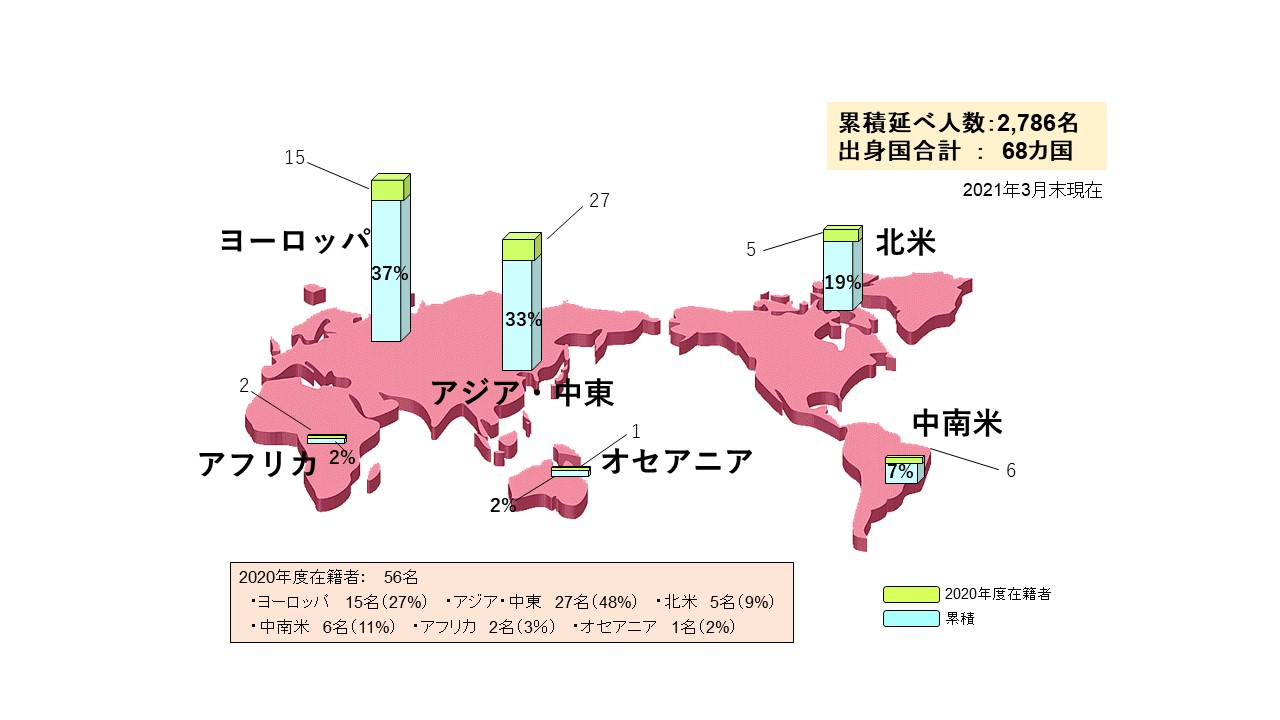 In line with our management principles of COE and globalization, ATR has actively promoted research and personnel exchanges not only within Japan but also with leading research institutions and universities overseas since its establishment.
ATR has maintained a richly international research environment, with foreign researchers consistently accounting for more than 20% of all researchers. Since its establishment, ATR has hosted a total of 2,786 foreign researchers from 68 countries, with participants coming in roughly equal proportions from the Americas, Europe, and Asia.
In line with our management principles of COE and globalization, ATR has actively promoted research and personnel exchanges not only within Japan but also with leading research institutions and universities overseas since its establishment.
ATR has maintained a richly international research environment, with foreign researchers consistently accounting for more than 20% of all researchers. Since its establishment, ATR has hosted a total of 2,786 foreign researchers from 68 countries, with participants coming in roughly equal proportions from the Americas, Europe, and Asia.
|
ATR Group Business Development Framework
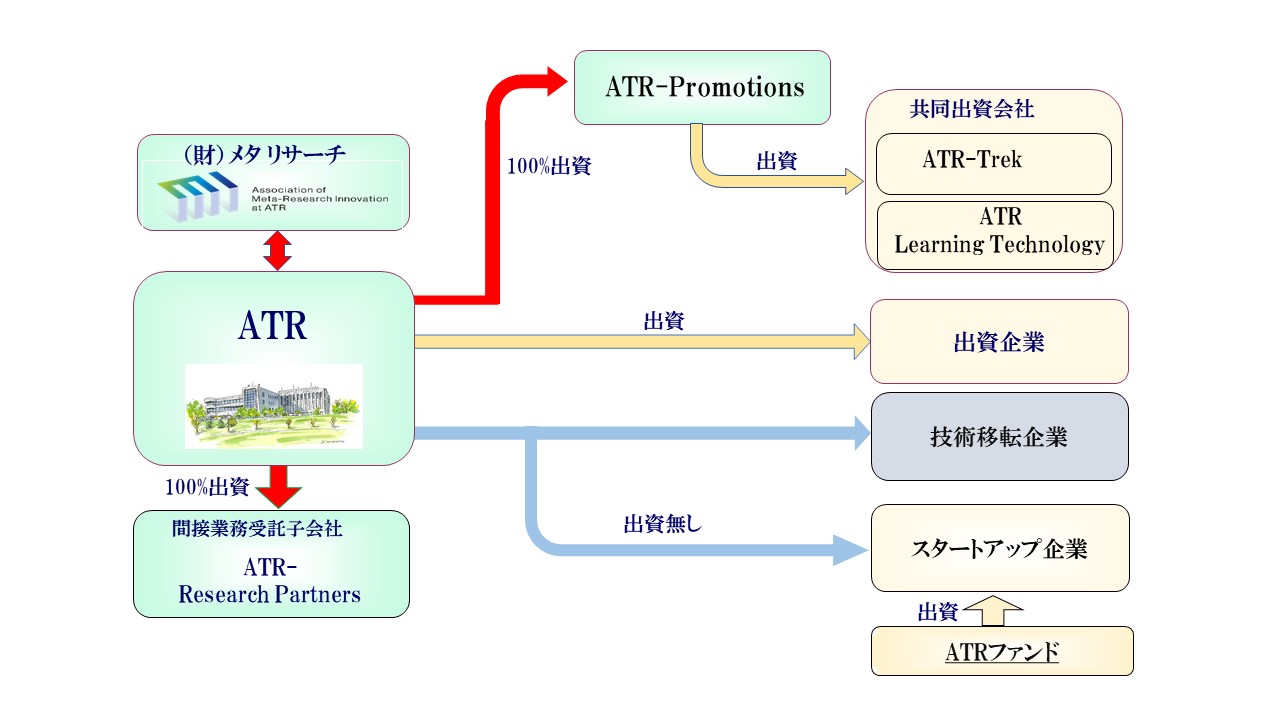 ATR formulates and shares its vision with the ATR Meta-Research Innovation Association.
Research outcomes in wireless communications and sensor technologies are commercialized either through direct sales via ATR-Promotions or through ATR’s investing companies.
In addition, technologies related to spoken language processing, which ATR has focused on since its founding, are developed into products and services through ATR Learning Technology, a jointly invested company of ATR-Promotions, and through ATR-Trek, as well as through investing companies and technology-transfer partners.
Research outcomes in brain information science, robotics, and avatar technologies, which have become especially active fields in the 21st century, are developed primarily through investing companies and technology-transfer partners.
ATR formulates and shares its vision with the ATR Meta-Research Innovation Association.
Research outcomes in wireless communications and sensor technologies are commercialized either through direct sales via ATR-Promotions or through ATR’s investing companies.
In addition, technologies related to spoken language processing, which ATR has focused on since its founding, are developed into products and services through ATR Learning Technology, a jointly invested company of ATR-Promotions, and through ATR-Trek, as well as through investing companies and technology-transfer partners.
Research outcomes in brain information science, robotics, and avatar technologies, which have become especially active fields in the 21st century, are developed primarily through investing companies and technology-transfer partners.Furthermore, through startup support using the ATR Fund, ATR has contributed to the establishment of many startup companies and promoted collaboration with them. |
Promoting the Keihanna Startup Ecosystem
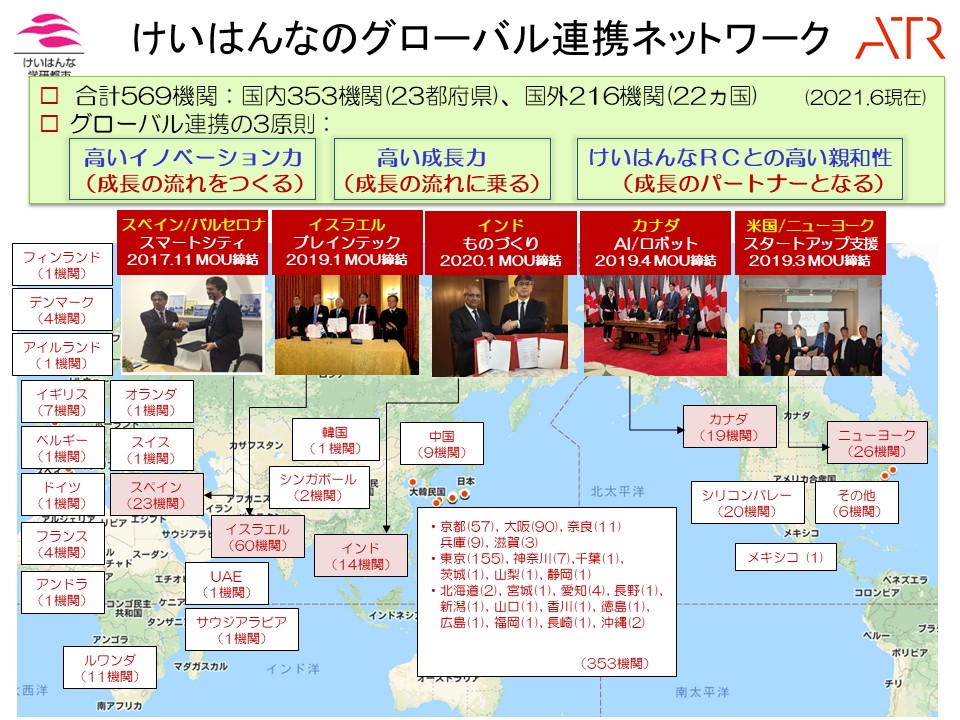 The Keihanna Research Complex Project, a national subsidy program of the Japan Science and Technology Agency (JST) launched in fiscal 2016, ended in fiscal 2019.
Building on its achievements, the Keihanna Research Complex Promotion Council was established in June 2020.
Under collaboration among industry, academia, government, financial institutions, and residents in Japan and overseas, ATR aims to advance cutting-edge R&D, social demonstration, commercialization, and human resource development in an integrated and autonomous manner. To support the overseas expansion of startups and promising medium-sized companies, we established the managing company XBorder Innovations, Inc. (XBI), which can provide management support and investment. Through collaboration and cooperation with 543 organizations, including 206 overseas organizations in 19 countries, primarily in New York, Barcelona, Israel, India, and Canada, ATR aims to form a global open innovation hub.
The Keihanna Research Complex Project, a national subsidy program of the Japan Science and Technology Agency (JST) launched in fiscal 2016, ended in fiscal 2019.
Building on its achievements, the Keihanna Research Complex Promotion Council was established in June 2020.
Under collaboration among industry, academia, government, financial institutions, and residents in Japan and overseas, ATR aims to advance cutting-edge R&D, social demonstration, commercialization, and human resource development in an integrated and autonomous manner. To support the overseas expansion of startups and promising medium-sized companies, we established the managing company XBorder Innovations, Inc. (XBI), which can provide management support and investment. Through collaboration and cooperation with 543 organizations, including 206 overseas organizations in 19 countries, primarily in New York, Barcelona, Israel, India, and Canada, ATR aims to form a global open innovation hub.
|